UV DTF vs Traditional UV Flatbed Printing: Which Fits Your Custom Business in 2026?
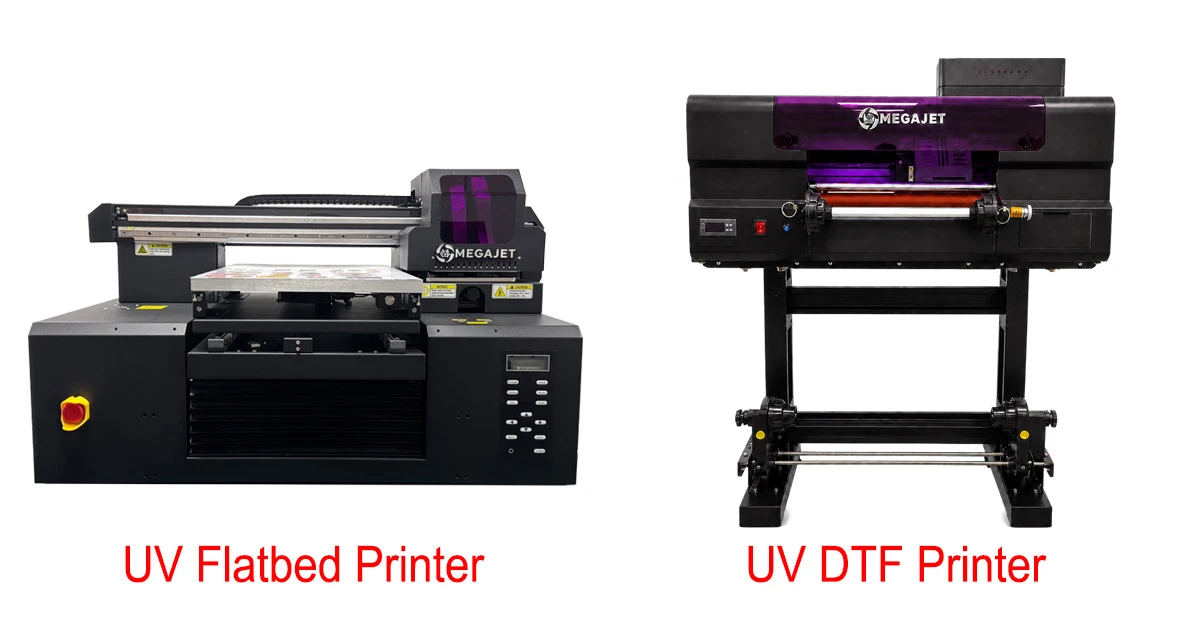
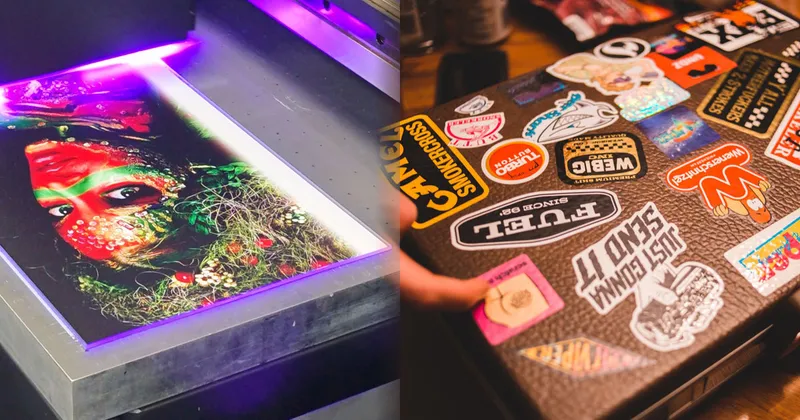
UV Flatbed direct printing vs UV DTF crystal transfer printing.
Table of Contents
When setting up or expanding a custom merchandise business in 2026, buyers often find themselves debating between two equipment paths: purchasing a direct UV flatbed printer for rigid substrates, or buying a dedicated UV DTF printer for crystal transfer stickers.
On paper, hardware evolution has introduced versatile 2-in-1 UV flatbeds (such as 4060 and 6090 formats with roll-feed and laminating attachments) that can print both rigid goods and UV DTF film.
However, in real daily workshop production, running a single machine for both jobs exposes a fundamental chemical challenge: choosing between Hard, Soft, and Neutral UV inks without costly ink flushes.
To help print shop owners, promotional product suppliers, and overseas distributors make an informed capital investment in 2026, this guide breaks down how direct flatbed printing and UV DTF compare, the reality of 2-in-1 hybrid setups, CCD visual positioning innovations, and the ink trade-offs that determine your true production workflow.
1. How the Technologies Work: Hardware & Process Comparison
Understanding the mechanical workflows of direct printing and transfer stickers explains why each method serves different custom applications.
Direct UV Flatbed Printing (Direct-to-Substrate)
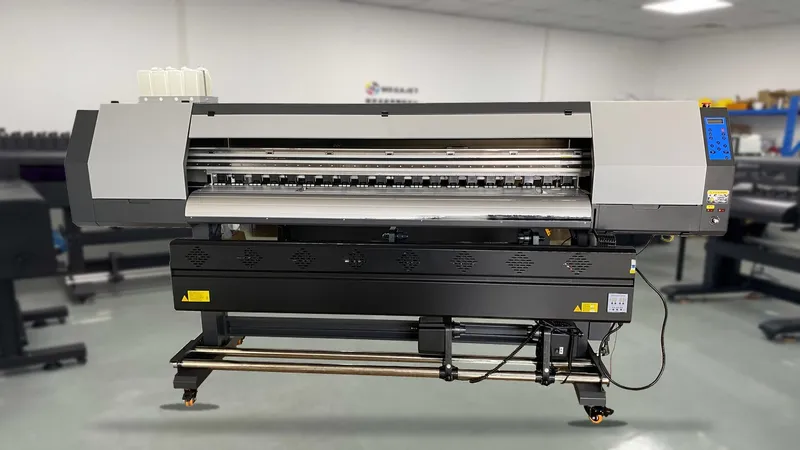
A commercial UV flatbed printer mounts micro-piezo printheads on a gantry carriage that moves along the X-axis, while the precision vacuum table moves along the Y-axis (or the gantry travels over a stationary bed).
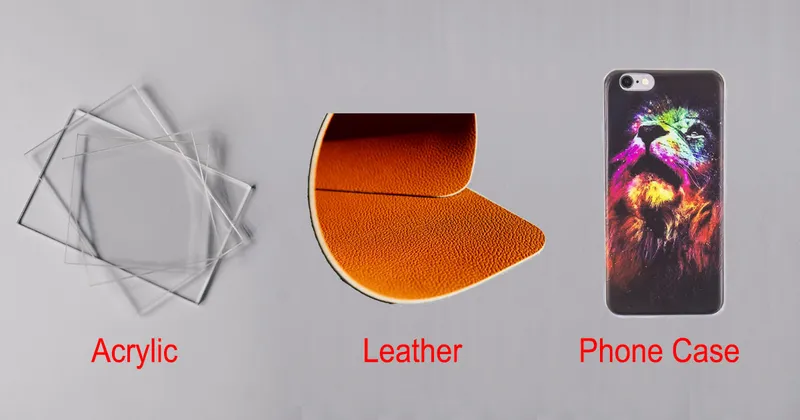
- Substrate Placement & Priming: The operator places rigid items (acrylic blanks, wooden plaques, phone cases, aluminum plates) onto the vacuum bed, often using laser-cut positioning jigs or CCD cameras.
Dense, non-porous materials like tempered glass, stainless steel, or glazed ceramics receive a quick wipe-on primer (coating) to ensure permanent chemical bonding.
Height Measurement: Depending on the printer configuration, an automatic optical height sensor measures substrate thickness, or the operator uses manual push-button jog controls to maintain a precise 1.5 mm to 2.0 mm clearance between the nozzle plate and the item surface.
Direct Jetting & Instant Curing: Micro-piezo printheads (such as the TX800, XP600, Epson i1600-e1, i1600-u1, or the industrial Epson i3200 printhead) jet White ink, CMYK color ink, and clear Gloss Varnish directly onto the object.
Water-cooled UV LED lamps follow the carriage to cure the ink instantly at 395 nm wavelength.
- Finished Product: The item is completely dry, cured, and ready for immediate packaging as soon as the print pass completes.
UV DTF Transfer Printing (Crystal Label Decals)
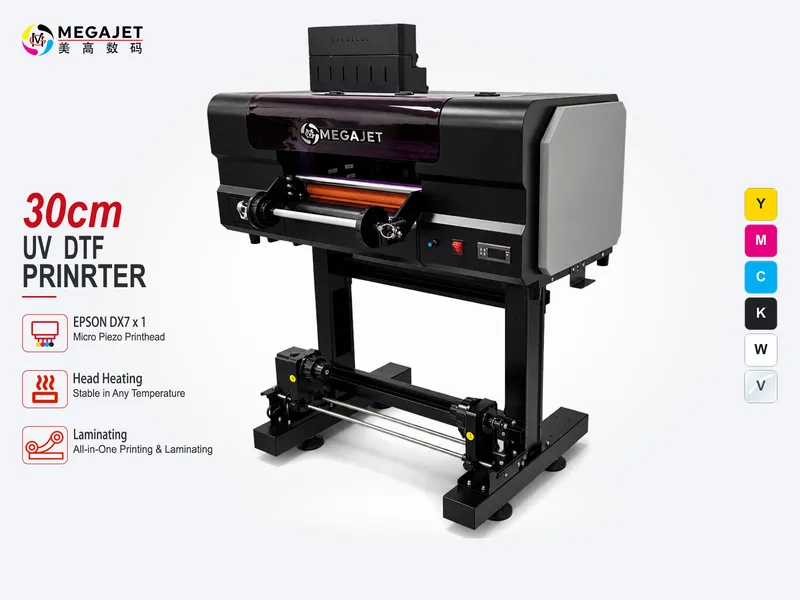
Dedicated roll-to-roll UV DTF printing (such as our 30 cm UV DTF printer) prints an indirect transfer graphic onto a specialized multilayer film system:
- Printing on Base Film (Film A): The roll feeder delivers Film A, which is coated with a release layer and high-tack pressure-sensitive adhesive.
Printheads jet White ink, CMYK color ink, and a thick protective layer of Gloss Varnish directly onto the adhesive.
In-Line UV Curing: UV LED lamps cure the ink and varnish layers on Film A.
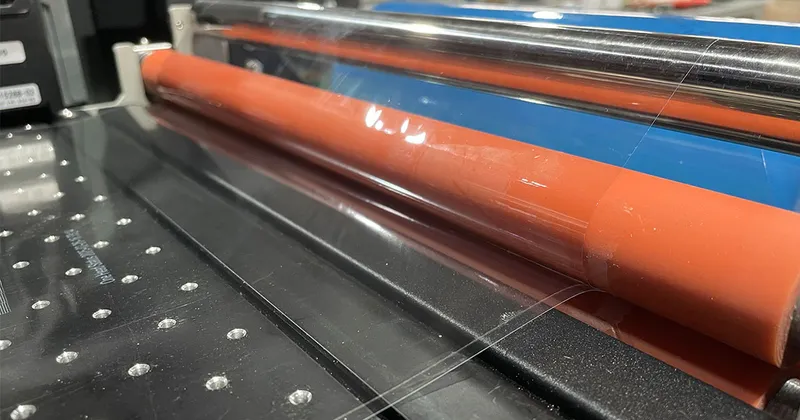
In-Line Lamination (Film B): As the printed film advances, an integrated laminating roller applies Film B (a transparent PET carrier film with positioning release properties) over the cured print.
Application: The user cuts the desired sticker from the roll, peels off the bottom Film A release backing, presses the graphic firmly onto the target product (rubbing with fingers or a squeegee), and peels away top Film B.
2. The 2-in-1 UV Flatbed Evolution: Possibility vs. Practical Reality
Many modern commercial flatbeds (including our 4060 UV flatbed printer and 6090 UV flatbed printer) can be equipped with a rear roll-feed and front take-up laminating attachment, enabling the vacuum bed to feed UV DTF film rolls.
| 2-in-1 Flatbed Mode | Application Focus |
|---|---|
| Direct Vacuum Bed Mode | Direct jetting on rigid blanks (Acrylic, Wood, Metal, Phone Cases) |
| Front/Rear Roll Film Mode | Roll-fed UV DTF film printing (Curved tumblers, Helmets, Large assembled machinery) |
The Advantage: For a startup or small workshop with limited space and budget, one machine physically handles both jobs without purchasing two separate hardware chassis.
The Practical Bottleneck (The Ink Compatibility Dilemma):
While the hardware can switch between flat blanks and roll film, the chemical ink setup inside the ink lines cannot change instantly.
UV DTF transfers strictly require Soft or Neutral UV ink. Because the cured graphic must peel, bend, stretch, and wrap around curved bottles or helmets, Hard UV ink will crack into white fractures during transfer.
Traditional flatbed printing typically runs Hard UV ink. Hard UV ink provides the highest pencil hardness (3H–5H), scratch resistance, and chemical durability on rigid acrylic, glass, and metal plaques. Soft ink on rigid acrylic can be easily scratched by fingernails.
The Ink Flushing Dilemma: If your 2-in-1 flatbed is loaded with Hard ink, your UV DTF stickers will be too brittle. If loaded with Soft ink, your rigid prints will lack scratch resistance. If loaded with Neutral ink, it is a workable compromise for light-duty goods, but switching between ink types requires completely flushing printheads and ink lines with cleaning solvent — wasting time, ink, and risking nozzle health.
Factory Perspective: A 2-in-1 flatbed loaded with Neutral UV ink is an excellent entry point for low-to-medium volume gift shops. However, once daily order volume grows, running dedicated machines (a Hard-ink Flatbed for rigid items + a Soft/Neutral-ink UV DTF roll printer) eliminates ink compromises and ink flushing downtime.
3. Technical Comparison: Direct Flatbed vs UV DTF
The following table summarizes the core operational differences between direct flatbed printing and UV DTF transfer methods:
| Comparison Parameter | Direct UV Flatbed Printing | UV DTF Transfer Printing |
|---|---|---|
| Printing Mechanism | Direct jetting onto objects on a vacuum bed | Roll-to-roll printing on Film A + in-line Film B lamination |
| Common Printheads | TX800 / XP600 / Epson i1600-e1 / i1600-u1 / i3200-u1 | TX800 / XP600 / Epson i1600-u1 / i3200-u1 / DX7 |
| Ideal Ink Formulation | Hard UV Ink (for maximum 3H–5H pencil scratch resistance) | Soft or Neutral UV Ink (for tensile flexibility without cracking) |
| Ink & Coating Channels | CMYK + White + Varnish (Wipe-on coating/primer for glass/metal) | CMYK + White + Thick Gloss Varnish (Heavy varnish mandatory for peel strength) |
| Consumable Consumption | UV Ink only (plus small amount of wipe-on primer on hard media) | Film A + Film B + UV Ink + Heavy Varnish layer |
| Substrate Compatibility | Flat, semi-flat, and regular cylinders (via rotary jig) | Flat, curved, conical, spherical, irregular 3D items |
| Maximum Object Height | 150 mm to 200 mm (limited by gantry Z-axis clearance) | Unlimited (Sticker applies to any assembled large item) |
| Height Adjustment | Automatic optical height sensor or manual jog button control | None on final product (printed on 0.1 mm flat film) |
| Drop Distance Limit | 2.0 mm to 3.0 mm (risk of overspray/blur beyond 5 mm) | None on final product (printed on perfectly flat base film) |
| Scratch Resistance | Excellent (direct chemical bond + primer on hard materials) | High (durable UV ink + high-tack pressure adhesive) |
| Adhesion Standard | ASTM D3359 Grade 4B–5B (cross-hatch tape test with primer) | Strong initial tack; reaches maximum bond strength after 24 hours |
| Water & Dishwasher Durability | Withstands repeated commercial dishwasher sanitizing cycles | Waterproof for routine washing; hand-wash recommended for drinkware |
| Jig / Tooling Requirement | Custom positioning molds needed for multi-piece batches (or CCD camera) | Zero molds or jigs needed |
| Blank Product Scrap Risk | High (carriage strike or nozzle misfire ruins product) | Zero (flawed graphics are reprinted on film) |
| Fulfillment Model | Local production (requires receiving client physical blanks) | Local application OR envelope mail shipping globally |
4. Consumable Structure & Workshop Economics
The operational difference between direct flatbed and UV DTF comes down to consumable structures and labor allocation.
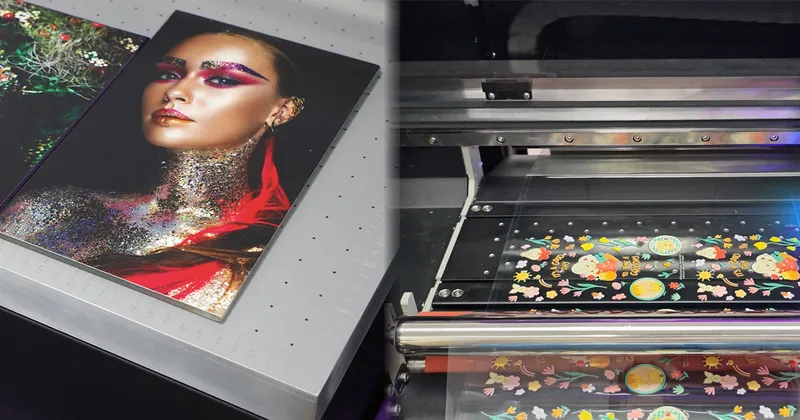
The Consumable Structure Gap
- Direct UV Flatbed: Only consumes UV curable ink (typically 12 ml to 18 ml per square meter under standard production passes).
On dense substrates like glass or stainless steel, a small amount of wipe-on chemical primer (coating) is wiped onto the surface before printing.
Because no carrier films are discarded, direct flatbed maintains the leanest per-unit material footprint.
- UV DTF Transfer: In addition to CMYK and White ink, UV DTF requires a dense layer of UV Gloss Varnish (which gives the transfer structural integrity to prevent tearing during peeling), plus the specialized AB Film roll system (Film A adhesive base roll and Film B transparent positioning carrier).
Because two specialized film rolls and heavier varnish volumes are consumed for every square meter printed, UV DTF has a higher consumable footprint per unit area.
The Tooling and Workflow Reality: Jigs, CCD Vision, and Gang Sheets
Beyond raw ink and film, workshop profitability is heavily dictated by tooling and operator loading time:
- Jig Tooling vs. CCD Visual Positioning on Flatbeds:
On a traditional flatbed, printing 50 custom keychains or phone cases requires laser-cutting an acrylic positioning fixture to hold blanks in precise X/Y alignment.
Today, advanced flatbed printers offer optional CCD Visual Positioning Systems (overhead industrial cameras and AI pattern recognition).
With CCD vision, operators can place small irregular blanks randomly across the vacuum bed; the camera captures the bed, recognizes part contours, and automatically offsets the print data for each item.
The trade-off: CCD vision increases machine purchase cost, requires clear visual contrast between the substrate and the table, and still requires batch loading and unloading.
UV DTF bypasses substrate handling during printing entirely by running continuous roll film.
- Operator Loading vs. Unattended Roll Printing:
Even with CCD vision, flatbed direct printing is inherently a batch-interrupted process: load bed → scan/align → print → unload bed.
A dedicated roll-to-roll UV DTF printer runs continuously unattended, printing hundreds of gang-sheet logos on a continuous roll.
- Blank Product Scrap Risk:
If a UV flatbed suffers a static discharge, head strike, or clogged nozzle mid-pass, the customer's blank product (such as a stainless steel thermal mug or leather bag) is permanently ruined.
With UV DTF, printing errors occur only on PET film, completely protecting high-value customer blanks.
5. Substrate Geometry & Drop Distance Limits
The physical shape of your products is often the decisive factor when deciding whether to print directly or transfer.
The 3 mm Drop Distance Rule on Flatbeds
Piezoelectric printheads eject ink droplets measuring 3.5 to 12 picoliters at velocities of 6 to 8 meters per second.
When the distance between the printhead nozzle plate and the substrate exceeds 2.5 mm to 3.0 mm, aerodynamic turbulence created by the high-speed carriage disperses the micro-droplets before they strike the surface.
This creates three visible defects on curved or recessed objects:
Edge fuzziness and blurred text.
Ink misting on unprinted areas.
Loss of color density and jagged lines.
While flatbeds can print standard cylindrical bottles using a motorized rotary attachment, they cannot print on conical drinkware with steep tapers, objects with handles (like ceramic coffee mugs), spherical surfaces, recessed compartments, or oversized machinery panels that exceed the machine's physical bed dimensions.
How UV DTF Decouples Printing from Object Geometry
UV DTF prints with maximum resolution (1440×1440 DPI or 2400 DPI) on a perfectly flat 0.1 mm PET base film where nozzle drop distance is always optimal.
Once laminated, the transfer sticker can be applied by hand to virtually any solid material regardless of geometry:
Tapered tumblers, flasks, and curved wine bottles.
Motorcycle helmets, skateboard decks, and power tool housings.
Assembled electrical cabinets, metal storage racks, and store windows.
Irregular wood carvings, custom guitar bodies, and leather luggage.
6. Durability, Adhesion & Real-World Testing
How well do the prints hold up under daily use, washing, and weather exposure?
Adhesion on Difficult Substrates
UV Flatbed (Direct): When paired with appropriate wipe-on chemical primers (coatings) on dense, non-porous surfaces like tempered glass, stainless steel, or ceramic tiles, direct UV ink creates a direct chemical bond. Tested under the standard ASTM D3359 cross-hatch tape test, properly cured UV flatbed prints achieve Grade 4B to 5B adhesion (0% delamination).
UV DTF (Transfer): UV DTF relies on oil-based polyacrylate pressure-sensitive adhesive. Initial tack allows immediate positioning, and bond strength increases significantly over the first 24 hours as the adhesive wets the substrate surface. On smooth plastics, painted metals, coated wood, and glass, the sticker resists strong peeling and scratching.
Water Exposure & Dishwasher Durability
UV Flatbed: High-end UV flatbed prints with primer withstand repeated cycles in commercial dishwashers and high-temperature sanitizing.
UV DTF: While UV DTF transfers are completely waterproof under normal cold and warm water exposure, prolonged exposure to high-temperature dishwasher steam (above 70°C) and harsh alkaline detergents can soften the pressure-sensitive adhesive around the graphic edges, leading to edge lifting over time. For customized drinkware and tumblers, hand-washing is recommended.
Flexibility and Fabric Limits
Neither standard UV flatbed nor standard UV DTF replaces conventional textile DTF (PET film + hot melt powder) for everyday elastic apparel like T-shirts or sportswear, where cured UV inks can fracture under heavy fabric stretching.
While UV technology is increasingly used for specialized apparel trims (such as thick-plate 3D dome badges and faux-embroidery thermal emblems), UV DTF transfers remain primarily engineered for hard and semi-rigid goods.
7. Which Equipment Fits Your Business?
Use this decision table to choose the right equipment setup for your workshop:
| Your Production Profile | Recommended Machine Setup | Ink Strategy |
|---|---|---|
| • Custom gift shops, sign makers, and startups wanting maximum flexibility on a budget • Need to print both flat rigid items AND irregular crystal stickers • Space-constrained workshop |
2-in-1 UV Flatbed Printer (Direct rigid printing on vacuum bed + integrated roll UV DTF film printing) |
Neutral UV Ink Balanced formulation allowing acceptable transfer flexibility on film and moderate scratch resistance on flat goods without ink flushing. |
| • Established factories with high-volume rigid production (acrylic awards, metal signs) • Demands maximum 4H–5H scratch hardness (optional CCD vision) |
Dedicated Commercial Flatbed | Hard UV Ink + Primers Dedicated hard ink delivers maximum chemical cross-linking density on non-porous rigid goods. |
| • High-volume gang-sheet e-commerce sticker producers running 24/7 roll production • Zero flat rigid direct printing requirements |
Dedicated Roll-to-Roll UV DTF Printer | Soft / Flexible UV Ink High elongation formulation ensures smooth wrapping around tight curves, flasks, and irregular goods without cracking. |
The Factory Recommendation
For Startups & Hybrid Gift Shops: A compact 2-in-1 UV Flatbed loaded with Neutral UV ink gives you 100% application coverage with a single hardware investment and zero machine footprint redundancy.
For High-Volume Industrial Operations: Running a Hard-ink Flatbed (with optional CCD vision) alongside a dedicated Soft-ink UV DTF Roll Printer provides the ultimate uncompromised production setup — eliminating ink-flushing downtime and ensuring maximum performance for both rigid and flexible jobs.
Plan Your Production Setup with Megajet
Selecting the optimal digital printing setup depends on your daily production requirements, target substrates, and fulfillment workflow.
If you are evaluating equipment for your workshop:
Send Your Substrate Details: Tell our engineers which products you plan to customize (dimensions, materials, curvature, expected output).
Request a Free Sample Pack: We will ship physical UV DTF transfer sheets and direct-printed flatbed samples produced at our manufacturing facility so you can test adhesion, ink flexibility, and scratch resistance on your own blanks before investing.
Custom Configuration & Ink Sizing: Contact the Megajet team for detailed pass-speed calculations, ink chemistry recommendations (Hard vs Soft vs Neutral), and machine sizing tailored to your business model.