i3200 vs 4720 Printhead: Why the Industry Shifted and What It Means for Your Printer
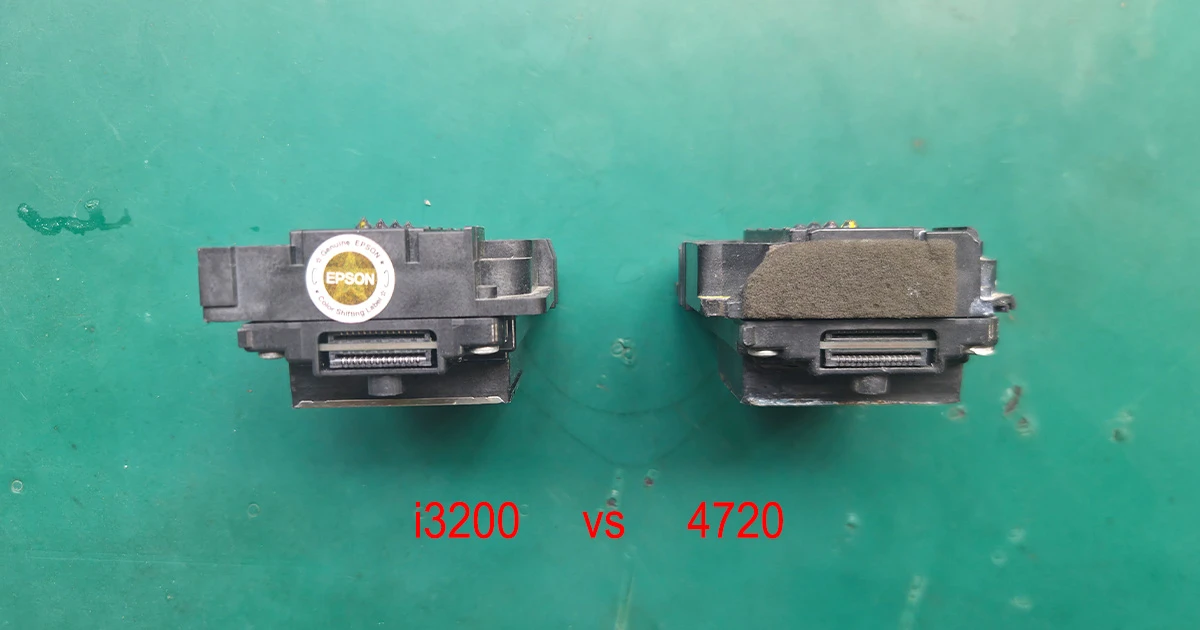
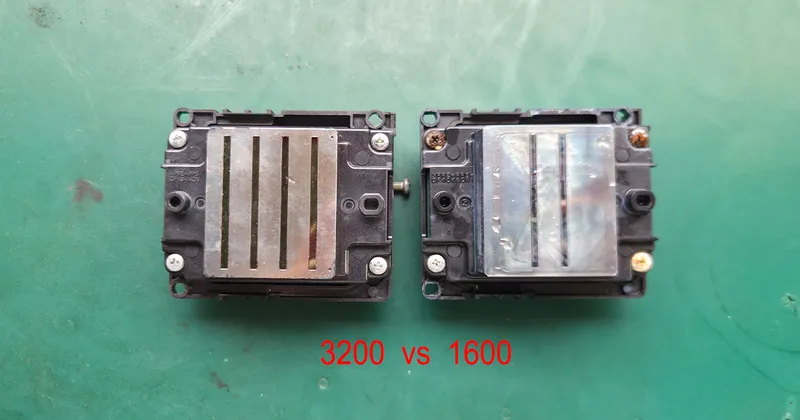
Epson i3200 (left, official OEM label) vs. Epson 4720 (right, desktop MicroTFP head): identical 3,200 nozzles and 33.8 mm print width, but distinct in hardware origin and industrial reliability.
Table of Contents
If you are researching direct-to-film (DTF) printers on B2B marketplaces, you will notice a significant price divide. Many suppliers offer budget 30cm (A3) and 60cm DTF printers equipped with Epson 4720 printheads (sometimes labeled as EPS3200), at a price that is often noticeably lower than an equivalent i3200 machine — the 4720 head itself typically costs around half the price of an i3200.
Because both printheads feature 3,200 nozzles across an identical 33.8 mm print width, buyers frequently ask us: Is an i3200 printer really worth the extra money over a cheap 4720 machine?
This is a fair question, so let us give you an honest factory answer. In daily print quality and speed, the 4720 and the i3200 are much closer than many sellers on either side like to admit. The real differences are in price, sourcing, ink compatibility, maintenance sensitivity, and long-term support — not in a dramatic quality gap.
Technical Specifications: Epson 4720 vs Epson i3200
Here is a side-by-side comparison of the core physical and engineering parameters:
| Parameter | Epson 4720 (EPS3200) | Epson i3200 (i3200-A1 / E1 / U1) |
|---|---|---|
| Classification | Harvested desktop printhead (from WF-4720 office printers) | Official Epson OEM industrial printhead |
| Total Nozzles | 3,200 nozzles (8 rows × 400 nozzles) | 3,200 nozzles (8 rows × 400 nozzles) |
| Nozzle Pitch / Resolution | 300 npi per row (600 npi across 2 combined rows) | 300 npi per row (600 npi across 2 combined rows) |
| Effective Print Width | 33.8 mm (1.33 inch) | 33.8 mm (1.33 inch) |
| Relative Head Price | About half the price of an i3200 | Standard industrial price |
| Supported Ink Chemistry | Water-based (aqueous) only — no UV or eco-solvent design | Dedicated sub-models: A1 (Water/DTF), E1 (Eco-solvent), U1 (UV) |
| Board Connection | Requires a decryption card (解密卡) adapter | Native plug-and-play on Hoson, BYHX, and Senyang |
| Firing Frequency | ~17 kHz (third-party board limit) | 21.6 kHz (single dot) / 43.2 kHz (multi dot) |
| Print Quality (daily jobs) | Very close to i3200; minor detail-level differences | Reference standard |
| Machine Output Speed | Similar to i3200 at the same head count and pass setting | Similar to 4720 at the same head count and pass setting |
| Warranty | None — printheads are consumables; no warranty once inked (Epson policy, same for all heads) | None — same consumable policy; but genuine OEM quality is guaranteed |
Where Do Cheap 4720 Heads Actually Come From?
To understand why 4720 machines are priced so cheaply, you have to look at the supply chain behind them.
The 4720 was never an officially sold industrial printhead. Around 2018, machine builders realized that Epson WorkForce desktop office multifunction printers (such as the WF-4720 and WF-4730) contained a compact 3,200-nozzle MicroTFP chip. What followed was a resale supply chain rather than a factory operation: desktop printers were bought in volume by resellers, dismantled to harvest the printheads, and the heads were then resold to machine builders, who built custom adapter boards to drive them in commercial sublimation and early DTF printers.
Because Epson never intended these desktop heads for commercial use, the manufacturer added firmware encryption that blocks third-party boards. Machine builders answered with decryption cards (解密卡) that sit between the board and the head. Over the years the market saw several encryption generations (一次锁, 二次锁, 三次锁), each needing a newer adapter. In most working systems the decryption card itself is reliable — its real drawbacks are that it is an extra hardware point in the signal path, and that the whole 4720 supply depends on harvested or surplus stock with no factory warranty.
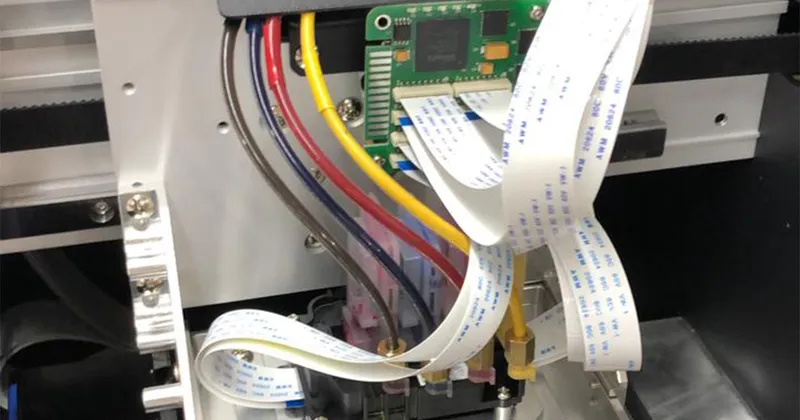
To serve the commercial market properly, Epson officially released the i3200 series in 2020. The i3200 is an authorized industrial OEM printhead that communicates directly with control boards without decryption cards.
Print Quality and Speed: The Honest Comparison
This section is important, because a lot of what you read online about the 4720 is exaggerated in both directions.
Print quality
For everyday DTF work — solid colors, photos, and gradients printed on PET film — a well-set 4720 machine prints very close to an i3200 machine. Both heads share the same Epson PrecisionCore MicroTFP architecture, the same 300 npi nozzle rows, and the same variable droplet technology. The average print shop would be hard pressed to tell the difference in normal production.
Independent side-by-side tests in China (a 2020 comparison run on a Wuhan Jingfeng board with an Epson-based frame) found microscopic differences: the 4720 produces slightly more satellite droplets and less perfectly round dot shapes than the i3200-A1. These show up mainly when you look closely at small text, thin lines, and gray gradients. For most daily print jobs the difference is minor.
Printing speed
There is a real difference in the head's firing frequency: the 4720 is typically driven at about 17 kHz by third-party boards, while the i3200 runs at a native 21.6 kHz — roughly a third more firing speed on paper.
However, on a complete DTF printer, actual output speed is decided by the whole machine — number of heads, pass count, carriage motor, white ink coverage, and powder shaker / dryer speed — not by the head frequency alone. In practice, a 4720 machine and an i3200 machine with the same head count and the same pass settings print at similar square meters per hour. The frequency advantage gives the i3200 more tuning headroom for board developers; it does not translate into a visible speed gap in a finished machine.
What Really Differs: Price, Ink, Sourcing, and Support
1. Price — the honest core of the 4720 story
The 4720 head costs roughly half the price of an i3200, and replacement heads are cheaper too. That is the real reason budget 4720 machines exist, and for a shop with a very tight budget and light daily volume, the lower entry cost is a genuine advantage. The trade-off is everything else on this list.
2. Ink type — 4720 is water-based only
The 4720 was designed for aqueous office inks. It has no UV version and no eco-solvent version. If your business is pure water-based DTF or sublimation, this is not a limitation — but if you plan to expand into UV or eco-solvent printing later, the 4720 cannot go with you. The i3200 family covers all three: A1 (water/DTF), E1 (eco-solvent), and U1 (UV).
3. White ink maintenance — true for every DTF head, more sensitive on the 4720
DTF white ink is loaded with titanium dioxide (TiO2) particles that settle quickly, and this is a maintenance challenge for every DTF printhead on the market — i3200 included. Daily printing, ink circulation, and regular nozzle checks are not optional on any DTF machine.
What is specific to the 4720 is that its internals are more sensitive to aggressive handling. Maintenance guides for 4720-equipped machines warn against high-pressure syringe flushing (it can blow the internal membranes) and against pure IPA cleaning fluid (it can strip the internal hydrophobic layer and cause ink bleeding). An i3200-A1 printhead, with its industrial resin seals, tolerates standard maintenance procedures better. None of this means a 4720 cannot run well — it means it needs a disciplined operator.
4. Sourcing condition and support
Because 4720 heads come from the harvest chain, every batch has a different story: surplus new-old stock in some cases, refurbished or used heads in others.
On warranty, both heads are equal: a printhead is a consumable part, and like every factory in this industry — and Epson's own policy — no head carries warranty once ink has been injected. The real difference is quality assurance. An i3200 is a genuine Epson OEM industrial part with consistent factory quality, traceable supply, and official waveform data shared with board makers (Hoson, BYHX, Senyang). A harvested 4720 has no such assurance — its condition depends entirely on the batch it came from.
What Should You Buy for DTF in 2026?
Here is our honest factory recommendation:
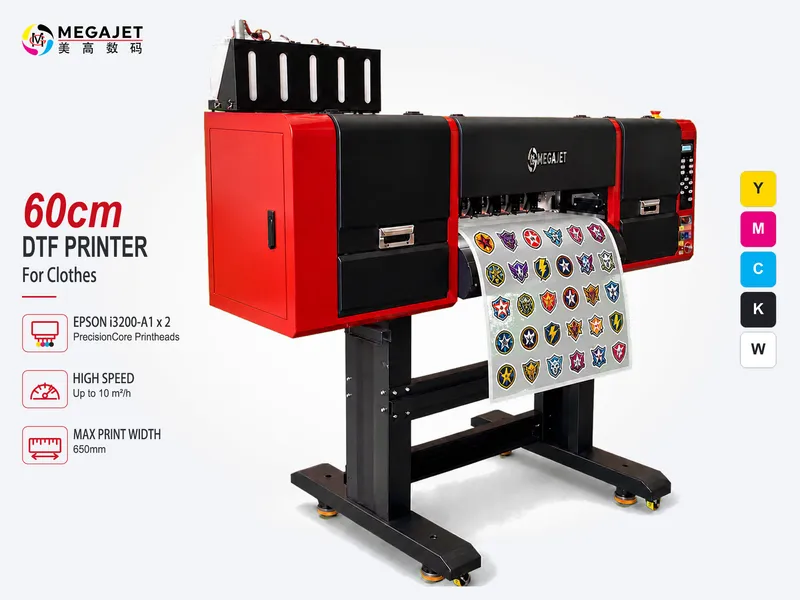
- For 60cm DTF production: Choose a dual-head i3200-A1 DTF printer or a 4-head i3200-A1 machine. It is the proven industry standard for garment decorators and print service providers — native board integration, no decryption adapters, and official support.
- For budget-conscious entry-level DTF (30cm or 60cm): If an i3200 machine is beyond your immediate budget, choose an i1600-A1 printer rather than an old 4720 machine. The i1600 is a genuine industrial PrecisionCore head (4 nozzle rows instead of 8) with the same chemical-resistant construction, native board support, and no decryption cards — at a lower price than an i3200.
- If you already own a 4720 machine: It can still produce good work if maintained carefully. When the head fails or you need more capability, ask your supplier about upgrading the carriage board to an official i3200 or i1600 conversion kit rather than buying another harvested 4720. For existing 4720 machines we also keep replacement Epson 4720 printheads in spare parts stock.
The low price of a 4720 machine is real, and for the right light-volume use case it can make sense. But for a business that depends on daily production, the combination of harvested sourcing with unverifiable quality, water-based-only ink, and no official Epson integration is why the industry has moved to the i-series. Choosing an authentic i-series head means your machine, your ink options, and your spare parts supply have a future.
To discuss the best printhead configuration for your production volume or learn more about our machinery, contact the Megajet engineering team or read more about our manufacturing facility.