Solvent vs Eco-Solvent Printing: Outdoor Durability, Odor, and Workplace Safety
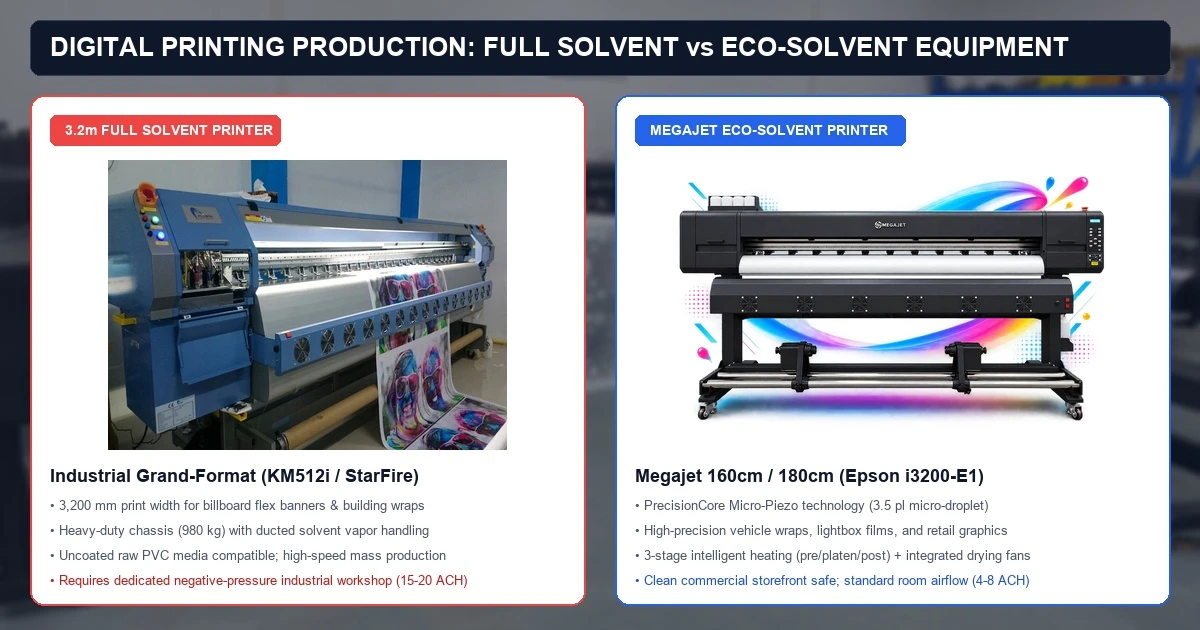
Solvent billboard banner production vs eco-solvent high-resolution vehicle vinyl printing.
Table of Contents
In the wide-format digital printing industry, equipment buyers and print shop owners frequently face a critical strategic decision: whether to invest in an industrial full-solvent machine or a modern eco-solvent roll-to-roll printer.
For years, full-solvent technology has served as the backbone of outdoor advertising, celebrated for its rugged durability and ability to print directly on untreated, low-cost PVC substrates.
However, rising commercial environmental standards, strict municipal VOC emissions controls, and growing operator health awareness have shifted significant market demand toward eco-solvent solutions.
At the same time, conflicting marketing claims have created widespread confusion: some vendors claim eco-solvent prints cannot survive intense sunlight, while others incorrectly label eco-solvent inks as completely zero-VOC fluids that require no workshop ventilation whatsoever.
As a dedicated digital printing equipment manufacturer focusing exclusively on eco-solvent, UV, and DTF technologies—and intentionally not building full-solvent machinery due to environmental and precision standards—Megajet provides this engineering guide to break down the real chemical mechanics, outdoor durability data, ventilation parameters, and equipment maintenance profiles across both technologies.
1. Ink Chemistry: Chemical Etching vs Thermal-Assisted Resin Bonding
The physical and chemical differences between solvent and eco-solvent printing begin in the formulation of the liquid ink carrier.
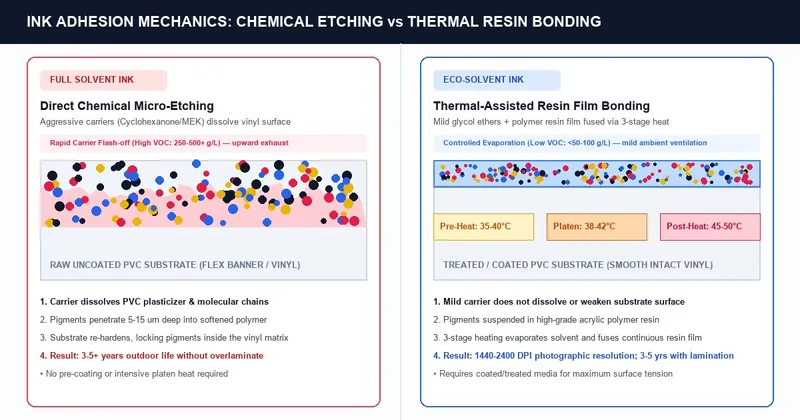
Full Solvent: Aggressive Chemical Etching
Traditional full-solvent inks (often referred to as hard solvent or true solvent) use aggressive, high-volatility organic compounds as their primary liquid carrier.
These formulations commonly rely on polar solvents such as cyclohexanone, isophorone, and aromatic hydrocarbon blends, yielding volatile organic compound (VOC) levels between 250 and 500+ g/L.
When full-solvent ink droplets land on raw, uncoated PVC flex banner or vinyl, the aggressive carrier actively micro-etches and dissolves the PVC plasticizer and polymer chains on the surface.
The pigment nanoparticles penetrate beneath the media surface, anchoring directly inside the softened polymer matrix.
As the solvent flashes off into the atmosphere, the vinyl re-solidifies, locking the pigment particles permanently inside the substrate structure.
This chemical etching mechanism allows full-solvent printers to achieve high mechanical bonding on the cheapest, rawest outdoor flex banners without requiring pre-coatings or high platen temperatures.
Eco-Solvent: Thermal-Assisted Resin Bonding
Eco-solvent inks replace hazardous volatile solvents with refined, high-boiling-point carriers, primarily glycol ether esters, propylene glycol ethers, and aliphatic ester derivatives.
Because glycol ether molecules possess mild chemical reactivity, they do not aggressively dissolve or etch the PVC polymer matrix.
Instead, eco-solvent ink relies on high-grade polymer resin binders suspended within the fluid to encapsulate the pigments and fuse them onto the substrate surface.
To achieve strong adhesion, eco-solvent printers depend on an integrated 3-stage heating control system:
Pre-Heater (35°C–40°C): Warms and softens the vinyl media prior to ink deposition, expanding media pore structure and improving droplet wetting.
Platen-Heater (38°C–42°C): Maintains controlled thermal energy directly under the print carriage, stabilizing ink droplet spread and preventing inter-color bleeding.
Post-Heater & Front Infrared Drying Fans (45°C–50°C): Accelerates the evaporation of glycol ether solvents and fuses the polymer resin into a continuous, flexible protective film over the vinyl.
Because the PVC surface is not chemically degraded, eco-solvent prints maintain clean color edges and smooth tonal gradients, but the media must feature adequate surface tension or specialized receptive coatings for maximum adhesion.
2. Outdoor Durability & Weather Resistance in Real Environments
Outdoor durability is measured by how well a print resists ultraviolet (UV) solar fading, moisture degradation, seasonal temperature shifts, and physical wind abrasion.
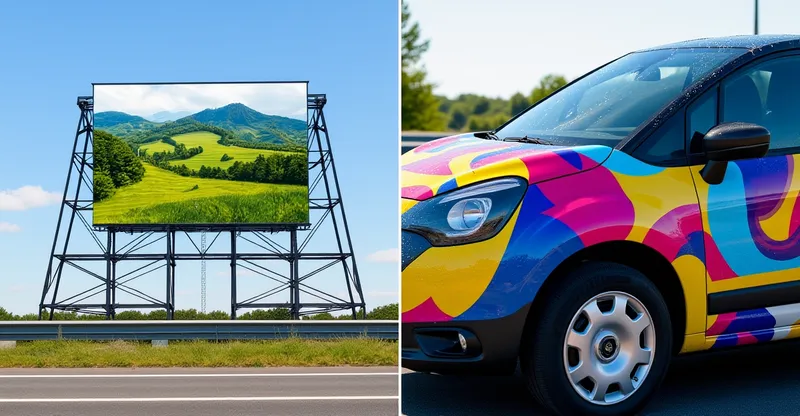
Unlaminated Durability: Full Solvent Holds the Edge
When displayed outdoors without any protective overlaminate, full-solvent prints offer superior long-term weather resistance.
Because the pigment particles are locked directly inside the etched PVC layer rather than resting on top of it, rain, snow, and surface friction cannot easily dislodge the colorants.
Under direct sunlight and harsh weather conditions, a quality full-solvent print on heavy-gauge flex banner reliably maintains its visual clarity for 3 to 5+ years unlaminated.
In comparison, unlaminated eco-solvent prints deliver an outdoor lifespan of 18 to 36 months (1.5 to 3 years) under similar exposure.
Because the eco-solvent ink layer sits as a resin film on the substrate surface, prolonged UV irradiation and acid rain gradually break down the exposed binder, leading to earlier chalking and fading if unprotected.
The Lamination Multiplier for Eco-Solvent
In commercial practice, eco-solvent prints rarely remain unlaminated when designated for high-value outdoor applications such as vehicle fleet wraps, outdoor retail signage, and window graphics.
Applying a clear UV-filtering cold lamination film completely changes the operational equation:
UV Shielding: The acrylic or cast vinyl overlaminate blocks up to 95% of incoming UV radiation, protecting the underlying eco-solvent pigments from photodegradation.
Mechanical Protection: Lamination provides physical resistance against highway gravel, brush abrasion from automatic vehicle car washes, and atmospheric pollutants.
Chemical Resistance: Protects against gasoline spills, cleaning chemicals, and urban road salt.
When laminated, an eco-solvent print easily achieves 3 to 5+ years of outdoor durability, matching full-solvent longevity while providing higher photographic resolution.
For standardized adhesion and durability verification on coated vinyl media, print shops can evaluate film bonding using the ASTM D3359 Standard Test Methods for Rating Adhesion by Tape Test.
3. Odor Profile, VOC Emissions, and Workplace Safety Standards
Workplace safety and air quality represent the most consequential dividing line between solvent and eco-solvent technologies.
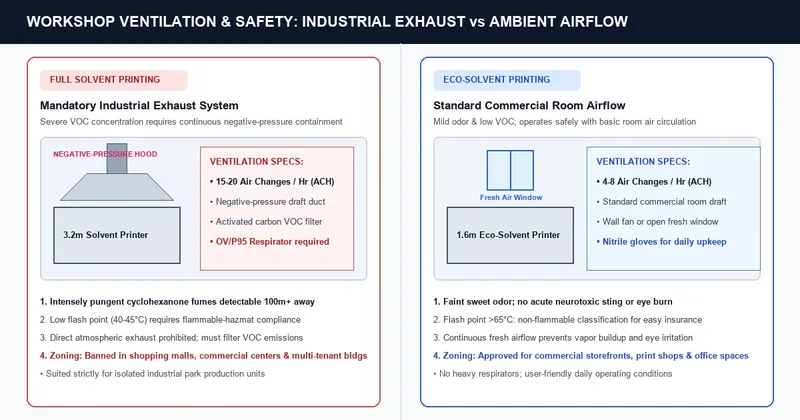
Full Solvent: Strict Industrial Containment Mandate
The aggressive chemical carriers that give full solvent its formidable outdoor bonding power also make it hazardous in enclosed spaces.
Cyclohexanone and related aromatic solvents possess an intense, sharp chemical odor that is instantly detectable at concentrations well below permissible exposure limits.
Chronic inhalation of concentrated solvent fumes can cause severe central nervous system symptoms, including dizziness, chronic headaches, respiratory tract inflammation, and nausea.
Furthermore, traditional solvents feature low flash points (typically 40°C–45°C), classifying them as flammable substances with strict storage and operating rules.
Operating an industrial full-solvent printer safely requires substantial infrastructure investments:
Dedicated Negative-Pressure Exhaust: The printer must be housed in an isolated, sealed room equipped with industrial ducted exhaust fans pulling fumes away from the operator's breathing zone.
High Air Exchange Rate: Ventilation systems must provide 15 to 20 room air changes per hour (ACH) to prevent the buildup of volatile fumes.
VOC Filtration & Emission Compliance: In many jurisdictions, exhaust air cannot simply vent raw into the atmosphere; it must pass through activated carbon filtration units or catalytic oxidizers to satisfy environmental regulations.
Personal Protective Equipment (PPE): Operators must wear half-face respirators fitted with organic vapor (OV/P95) cartridges, chemical-resistant nitrile gloves, and protective eyewear during machine operation and maintenance.
Because of these risks, municipal fire codes and environmental laws in North America, Europe, and major Asian cities strictly prohibit full-solvent printers in commercial shopping complexes, retail storefronts, and multi-tenant office buildings.
Eco-Solvent: Dispelling the "Zero Ventilation" Myth
Eco-solvent inks produce a remarkably mild, faint sweet odor during printing, making the workshop environment far more comfortable for daily staff.
The high flash points of glycol ether formulations (>65°C) classify them as non-flammable fluids, significantly simplifying insurance requirements, freight shipping, and workshop safety protocols.
However, marketing claims that eco-solvent is "100% non-toxic" and "requires zero ventilation" are misleading and dangerous.
While eco-solvent carriers lack aggressive neurotoxic agents, evaporating glycol ethers still displace breathable oxygen and can cause eye irritation or lethargy if trapped in an unventilated room for hours.
Responsible print shops running eco-solvent equipment should implement standard commercial airflow:
Continuous Ambient Airflow: Standard open-window cross-ventilation or a basic commercial wall-mounted exhaust fan providing 4 to 8 air changes per hour (ACH) is sufficient to maintain clean, safe air.
No Heavy Respirators Needed: Operators do not need cumbersome respirators during normal print runs. Standard disposable nitrile gloves are recommended during routine head wiping and ink refilling to prevent skin drying.
Broad Commercial Zoning: Eco-solvent printers can operate legally inside retail strip centers, quick-print copy shops, suburban industrial parks, and design studios without triggering industrial chemical inspections.
4. Machine Hardware, Printhead Architecture, and Daily Maintenance
The chemical disparity between the two ink chemistries dictates distinct engineering choices for printheads, fluid delivery tubing, and maintenance routines.
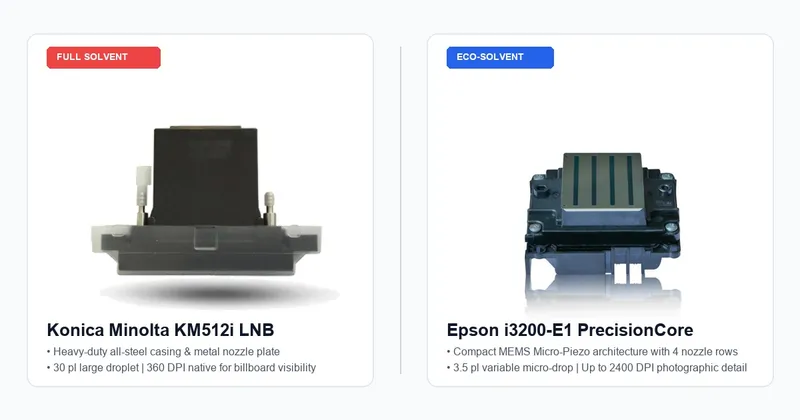
Printhead Technology: Drop Size and Optical Resolution
Full-solvent printers prioritize high firing power and physical resilience over microscopic dot precision:
Industrial Steel Heads: Common configurations utilize Konica Minolta 512i / 1024i (13 pl or 30 pl), StarFire SG1024 (25 pl to 80 pl), or Seiko 508GS printheads.
Coarse Droplet Volume: Native droplet sizes ranging from 13 pl to over 40 pl deliver thick ink coverage, but produce visible graininess when viewed within 1 to 2 meters.
Viewing Distance Optimization: Ideal for billboard formats viewed from 5 to 50 meters away, but unsuitable for fine text under 6 pt or photographic portraits.
In contrast, modern eco-solvent printers focus on high optical definition and smooth tonal transitions:
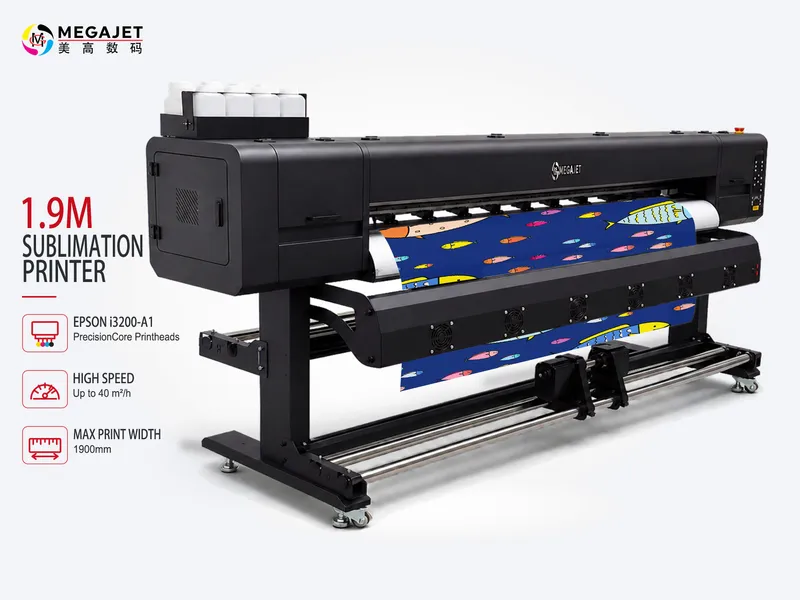
PrecisionCore Thin-Film Heads: Commercial equipment such as the Megajet 160 cm Eco-Solvent Printer — Epson i3200-E1 utilizes genuine Epson
i3200-e1ori1600-e1industrial printheads.Variable Micro-Droplets: Capable of firing droplets as small as 3.5 pl, achieving true photographic quality at resolutions up to 1440 × 2400 DPI.
Close-Range Visual Fidelity: Perfect for vehicle graphics, cosmetics lightbox posters, and corporate retail branding inspected at arm's length (<0.5 m).
For a deeper look into nozzle density and production speed tradeoffs across different head models, review our detailed guide on Epson i3200 vs i1600 printhead selection.
Fluid Lines and Idle Maintenance Routines
The fluid delivery plumbing reflects the chemical aggression of each ink:
Full-Solvent Plumbing: Every damper, gasket, valve, and hose must be fabricated from specialized fluoropolymers (PTFE/Teflon) and fluoroelastomers (Viton/FKM). Standard silicone or rubber tubing will swell, soften, and burst within 24 hours of contact with cyclohexanone.
Shutdown Maintenance Protocols: Full-solvent inks dry rapidly upon exposure to air. If an operator turns off a solvent machine overnight without bathing the nozzle plate in aggressive wash solvent, nozzles will form hardened chemical crusts. An unmaintained long weekend can permanently destroy a printhead bank.
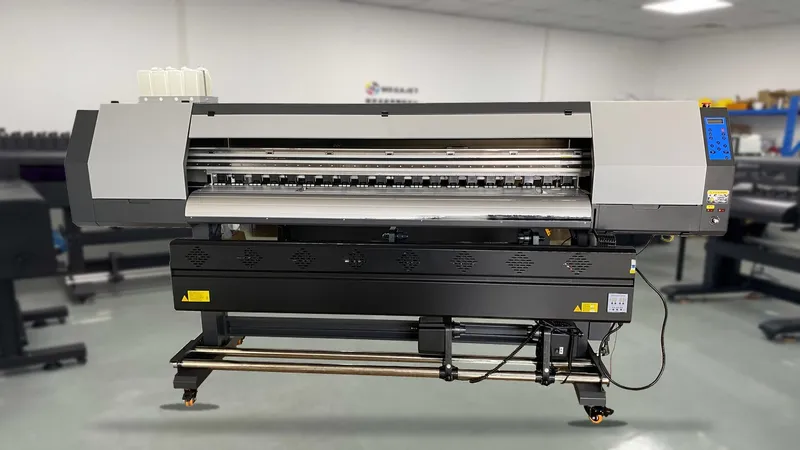
Eco-Solvent Automated Maintenance: Eco-solvent printers utilize integrated capping stations equipped with high-grade sealing rubber.
Paired with genuine eco-solvent ink, the carriage automatically docks onto an airtight moisturizing cap when idle, keeping the nozzle face lubricated for 3 to 5 days without manual intervention or solvent purging.
5. Comprehensive Engineering & Operational Comparison Table
The following technical comparison outlines the core operational, chemical, and environmental parameters between full-solvent and eco-solvent digital printing equipment.
| Parameter | Full Solvent (Hard Solvent) | Eco-Solvent (Mild Solvent) |
|---|---|---|
| Primary Chemical Carrier | Cyclohexanone, Isophorone, Aromatic blends | Glycol ether esters, Propylene glycol ethers |
| VOC Emission Content | 250–500+ g/L (High VOC) | <50–100 g/L (Low VOC) |
| Odor Profile | Intensely pungent chemical stench | Faint, mild sweet chemical scent |
| Flash Point | Low (40°C–45°C, Flammable classification) | High (>65°C, Non-flammable shipping) |
| Workshop Ventilation Need | Mandatory negative-pressure ducting (15–20 ACH) | Standard room ventilation / open airflow (4–8 ACH) |
| Operator PPE Required | Organic vapor respirators (OV/P95) + nitrile gloves | Disposable nitrile gloves during maintenance |
| Commercial Zoning Feasibility | Restricted to isolated industrial zones | Approved for retail shops and commercial centers |
| Typical Printhead Models | Konica Minolta 512i/1024i, StarFire SG1024 | Epson i3200-e1, i1600-e1, XP600 |
| Native Droplet Volume | 13 pl to 40+ pl (Coarse drop size) | 3.5 pl to 12 pl (Micro-piezo variable drop) |
| Maximum Print Resolution | 360–720 DPI | 1440–2400 DPI |
| Unlaminated Outdoor Life | 3 to 5+ years unlaminated | 18 to 36 months unlaminated |
| Laminated Outdoor Life | Rarely laminated (cost-prohibitive on bulk jobs) | 3 to 5+ years with UV cold lamination |
| Substrate Compatibility | Raw, uncoated flex banner, PVC, mesh | Coated banner, cast/calendered vinyl, canvas |
| Substrate Heating Demand | Minimal to moderate platen heating | Mandatory 3-stage heating (pre/platen/post) |
| Standby Idle Tolerances | High risk; requires daily manual solvent wash | Automated auto-capping seals heads for 3–5 days |
6. Distributor & Print Shop Decision Framework: Matching Tech to Your Business
Digital printing equipment is an investment in production capacity, operating cost, and market positioning.
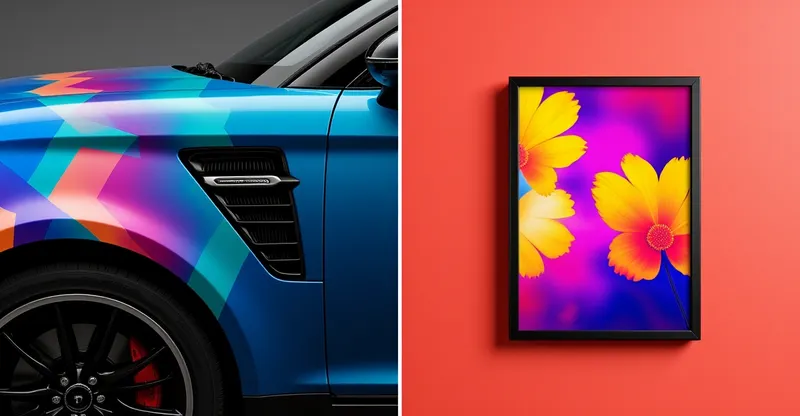
When to Invest in Full Solvent Equipment
Choose an industrial full-solvent machine (typically in 3.2 m or 5 m wide formats) if your business matches the following profile:
Volume Outdoor Billboard Production: Your primary revenue comes from roadside billboards, building wraps, scaffolding mesh, and transit bridge headers viewed from distances greater than 5 meters.
Raw Substrate Cost Sensitivity: You must run the cheapest, rawest, unbacked frontlit and backlit PVC flex banners where coating costs would destroy your competitive margin.
Dedicated Industrial Facility: You own or lease an isolated industrial facility permitted for ducted chemical exhaust, VOC filtration towers, and hazardous solvent storage.
Dedicated Maintenance Crew: You have trained operators capable of executing daily manual solvent washes and systematic fluid line purges.
When to Invest in Eco-Solvent Equipment
Choose a modern eco-solvent roll-to-roll printer (in 1.6 m, 1.8 m, or 3.2 m formats) if your business requires:
High-Resolution Signage and Fleet Graphics: Your core catalog includes vehicle wraps, corporate fleet branding, retail lightbox films, cosmetics window displays, and exhibition posters inspected at close range (<1 m).
Commercial Streetfront Operation: Your shop operates in a commercial shopping area, retail park, or suburban strip mall where harsh chemical fumes, intense smells, and industrial exhaust chimneys are strictly prohibited.
Operator Comfort and Low Turnaround Friction: You want a clean, user-friendly working environment where operators can run multiple machines with minimal fatigue and automated capping station convenience.
Flexible Media Breadth: Beyond vinyl banners, you produce wall canvas, photographic films, self-adhesive stickers, heat transfer vinyl for sportswear, and floor graphics.
If your production also involves direct printing onto rigid sheets such as acrylic panels or wood boards, evaluate our hybrid comparison between UV flatbed and roll transfer technologies to see whether a UV system should complement your roll workflow.
7. Factory Consultation & Substrate Adhesion Testing
Selecting between solvent and eco-solvent printing is not about deciding which technology is universally better; it is about matching chemical performance to your local environmental regulations, target media, and viewing distance requirements.
At Megajet, our factory specializes exclusively in modern eco-solvent, UV, and DTF digital equipment; we do not manufacture traditional full-solvent printers. We made this strategic choice because commercial sign and graphics production is permanently shifting toward higher resolution, operator health, and strict environmental compliance.
If you are evaluating whether an Epson i3200-e1 eco-solvent system can handle your regional outdoor climate, media profiles, and local compliance rules, our engineering team is here to assist.
You can send your substrate specifications or mail blank media samples directly to our manufacturing facility; our lab will perform standardized cross-hatch adhesion tests, weather-resistance evaluations, and calculate per-square-meter ink consumption figures for your specific application.
To discuss custom roll-to-roll configurations, container freight shipping, or regional distributorship opportunities, please contact our technical team today.